
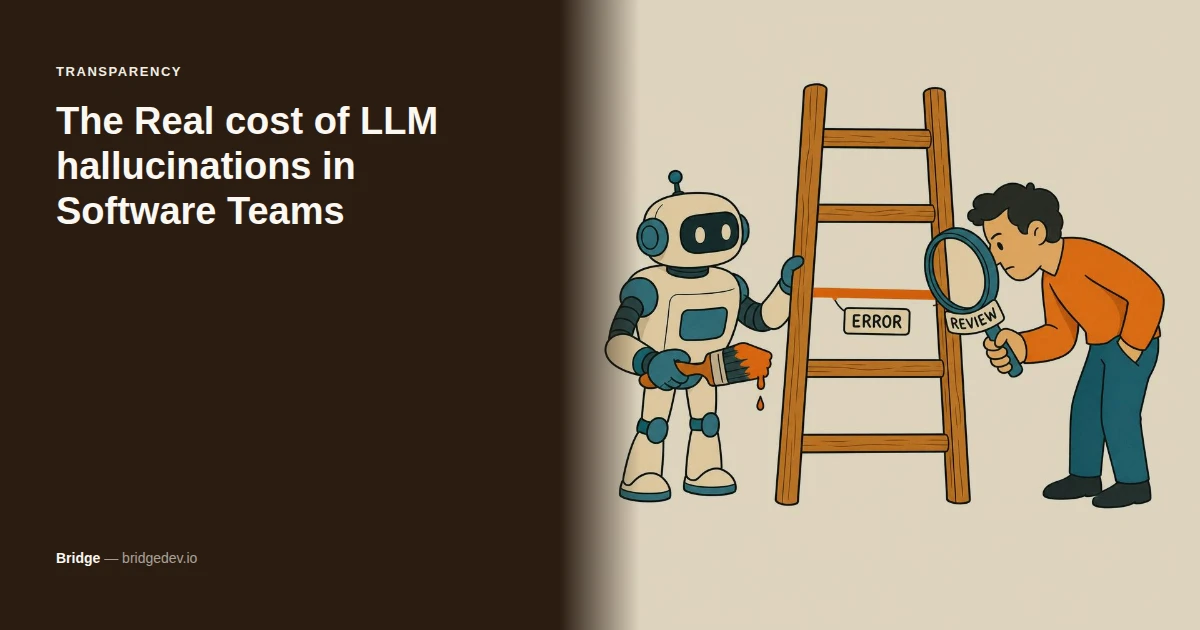
Generative coding models accelerate syntax production, but unvetted outputs introduce silent architectural defects that evade compiler checks. The true cost of LLM hallucinations is paid in downstream debugging, where engineering teams spend valuable time untangling corrupted schemas and broken state. The durable answer is structured, human-verified specification before generating executable code.
Key takeaways
- Syntax errors fail fast and carry minimal remediation overhead; silent semantic hallucinations pass CI checks and compound across the entire application lifecycle.
- Debugging a hallucinated schema after database migration consumes senior engineering time and depletes team runway.
- Multi-agent autonomous code generation compounds silent errors unless developers inspect intermediate schema and interface boundaries first.
- Pre-code specification of pillars, user stories, and data schemas intercepts hallucinated edge cases when intervention takes minimal effort.
The hidden cost of LLM hallucinations in mobile planning
When a large language model generates code with broken syntax or invalid imports, the compiler halts the build immediately. The developer spots the red squiggly line or the stack trace, prompts the model for an adjustment, and resolves the issue immediately. That failure mode is visible, deterministic, and cheap to fix.
The true cost of LLM hallucinations stems from a fundamentally different failure mode: the silent semantic hallucination introduced during the initial planning and specification phase. In this scenario, the generated code runs without errors, passes type checks, and satisfies naive unit tests. Beneath the surface, however, the model hallucinated an assumption about system state, data persistence, or user identity.
Consider a mobile application requiring local offline persistence and background synchronization. A developer prompts a coding agent to scaffold the authentication layer and local database cache. The model produces valid TypeScript and SQLite migrations, but it quietly assigns client-generated timestamps to optimistic record updates without handling clock drift or monotonic sequence enforcement. Because no compiler check flags the omission, the code lands in the main branch. The architectural flaw remains dormant until clients synchronize concurrent edits against the backend, quietly corrupting records across production databases. Isolating that error later requires tracing distributed state across offline caches and server tables, turning an unnoticed planning error into protracted forensic triage.
How silent LLM errors escalate development time
In software engineering, the remediation cost escalates for every stage a defect advances past the design phase. LLM errors in development follow this exact dynamic: catching an assumption early requires editing a sentence in a specification, whereas refactoring model output after deployment requires database migrations, cache invalidations, and client rollouts.
Defect Stage         Remediation Path               Remediation Impact
---------------------------------------------------------------------
Planning / Schema    Update field in specification   Immediate text edit
Active Generation    Edit prompt and re-run build    Prompt refinement
Post-Merge Testing   Trace logs and patch models     Deep triage and patching
Production Data      Backfill, migrate, hotfix PR    Data backfill and deployment
When teams calculate the financial drag of silent model failures, they should avoid relying on unverified industry figures. The genuine cost is direct and measurable: it equals the hours spent tracing, reproducing, and patching the defect multiplied by the engineering team's hourly rate, plus the operational expense of delayed product releases. We detailed the mechanics of this compounding expense in our analysis of managing dev tool costs.
Debugging model-generated code that contains semantic errors is distinctly more complex than debugging human-written code. Because the developer did not write the implementation line by line, they lack an internal mental model of the control flow. They must first reverse-engineer the generated logic, discover which implicit assumptions the model introduced, and determine whether fixing the immediate bug breaks downstream dependencies.
The impact of hallucinated edge cases on mobile app architecture
Silent planning errors manifest severely in mobile database schemas and state machines. A prime example involves entity identifiers in distributed systems. A team prompts a code generation tool to define schemas and entity models for an event-driven mobile feed. The model defaults to UUIDv7 because training data marks it as a modern, time-sortable standard. However, as documented in technical analyses of UUIDv7 implementation quirks, implementations that generate multiple identifiers within the same millisecond timestamp often lack guaranteed sub-millisecond monotonicity unless explicitly configured with counter bits.
If the model produces a standard UUIDv7 generator without monotonic guarantees, batches of mobile telemetry sent from client devices will cause out-of-order records in production pipelines. Diagnosing why chronological feeds display non-deterministic ordering does not trigger a database alert. Instead, the engineering team must navigate four distinct recovery stages:
- Incident Triage and Telemetry Tracing: Senior engineers audit network gateways, suspecting mobile latency or queuing jitter.
- State Replication: QA and product engineers attempt to replicate inconsistent sort states across varied device operating systems.
- Root-Cause Discovery: A developer inspects the model-generated utility and discovers the random bits within the millisecond block do not preserve strict monotonicity.
- Data Remediation and Schema Migration: The team writes migration scripts, alters client database schemas, invalidates cached records, and submits mobile hotfixes through app store review cycles.
This failure mode is exacerbated by autonomous multi-agent systems. Developer tools increasingly chain autonomous planners, coders, and reviewers behind a single prompt interface. Platforms such as Lovable explain their agent architecture as specialized agents passing context back and forth to refine output, while recent explainability acquisitions attempt to make code easier to understand after generation.
However, hiding intermediate decisions inside an autonomous loop conceals architectural drift. When an agent creates an interface with flawed assumptions, downstream coder and reviewer agents simply write tests to confirm the flawed logic. The pull request passes CI with a suite of passing unit tests, yet the application contains critical architectural planning pitfalls—such as allowing unauthenticated guest users to write local storage entities that require remote relational foreign keys on checkout. Resolving this discrepancy post-generation forces teams into deep structural refactoring, as explored in our post on preventing automated coding mistakes.
Catching hallucinations early: The planning phase advantage
The most effective method for eliminating the downstream cost of LLM hallucinations is shifting verification upstream into the specification phase. An error intercepted in a structured plan requires updating a text document or schema definition. It avoids database backfills, API deprecation notices, and app store resubmissions.
Bridge enforces this principle by treating planning as execution. Notes captured on a phone group into constellations, and a constellation becomes a Build Plan, a set of markdown files a developer or coding agent builds from, including the data model, the user flow, ordered tasks and acceptance criteria. An error caught in the plan's data model is fixed by editing a text file, not by writing a migration. Investing effort in this high-yield planning phase allows teams to avoid the prompt-to-app trap and catch hallucinations before they reach a database or compiler.
What is the true cost of LLM hallucinations for indie developers?
When a hallucinated schema reaches production, the immediate technical consequence is downstream parser failure. As detailed in architectural analyses of production model pipelines and fallbacks, invalid field structures or hallucinated data types break client parsing logic and trigger unhandled runtime exceptions. In a mobile environment, these runtime faults cause cascading application crashes on launch or during background synchronization.
For an engineering team with dedicated infrastructure and site reliability personnel, a broken schema is an operational ticket. For a solo founder, it is an existential operational disruption. Operating without a team to absorb triage, the founder pays a steep cost: creative product work halts entirely, and every hour of focus shifts into manual verification, trajectory tracing, and emergency database patching. The supposed velocity gained from rapid code generation evaporates during the hours spent writing custom migrations to repair corrupted client records.
The deeper loss is structural and often permanent: early user trust. Unlike enterprise web software where users might tolerate a transient error banner, mobile users penalize crashes immediately with app uninstalls and one-star app store reviews. Once corrupted local state crashes a mobile application, no amount of prompt tweaking can recover that cohort of users or erase public marketplace ratings. For a solo founder working with finite early momentum, shipping an unvetted schema does not just burn time—it burns the initial reputation required to survive.
The long-term answer
The long-term answer to model hallucinations is not more layers of autonomous code generation; it is strict human oversight at explicit architectural checkpoints. Generative models excel at synthesis when bounded by precise constraints, but they fail silently when granted open-ended authority over system architecture.
Teams that maintain technical leverage in the coming years will treat the development process as a pipeline of verified artifacts. By separating specification from implementation, you ensure that every line of generated code adheres to an audited, human-verified data model and UX contract. To establish this workflow in your current stack, read our guide on adopting a structured workflow for agent coding.
Frequently asked questions
What causes silent hallucinations in software development?
Silent hallucinations occur when an LLM lacks the holistic context of your application architecture. The model generates code that is syntactically correct and idiomatic in isolation, but invalid within your specific state, security, or data sync model.
Why are schema errors more dangerous than algorithmic bugs?
Algorithmic bugs can usually be patched with a localized code deploy. Schema errors corrupt persistent records on user devices and remote databases, requiring complex data migrations, synchronization logic, and manual data fixes to repair.
How does upfront planning stop model hallucinations?
Upfront planning confines the model to small, reviewable decision boundaries. By verifying data schemas and user flows before generating code, developers catch logical omissions and edge cases while the operational cost to fix them is near zero.