
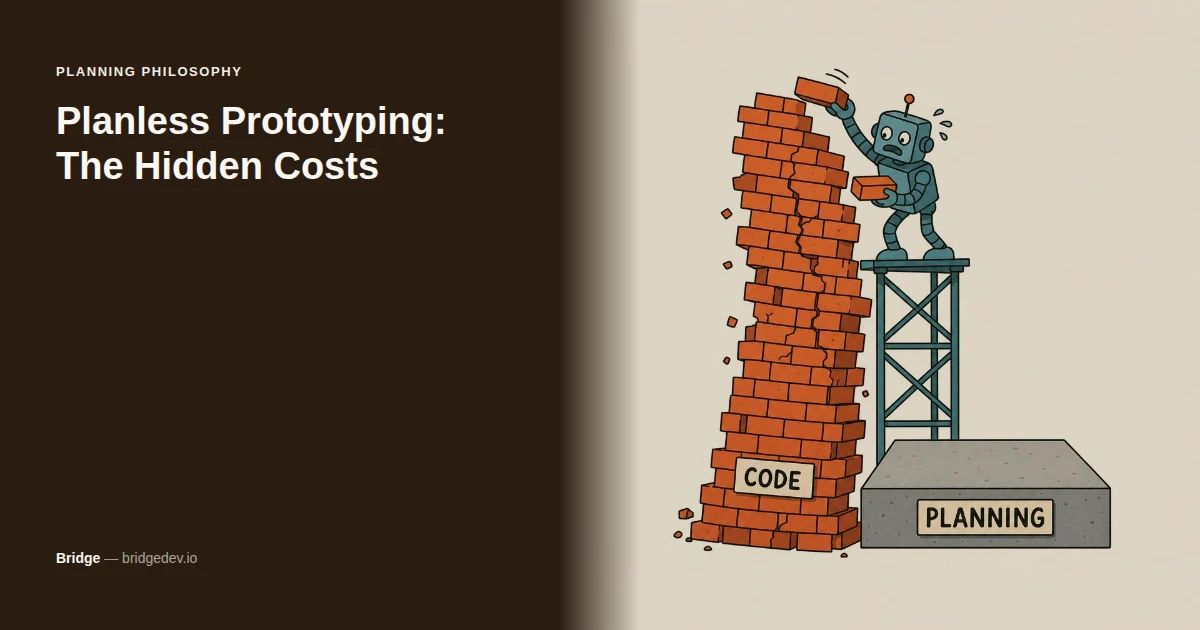
Jumping straight into automated code generation creates the illusion of velocity, but planless prototyping incurs compounding technical debt before the first commit lands. Fast code generation cannot compensate for an undefined system architecture. Sustainable mobile engineering requires front-loading the decisions: validating core pillars, user stories, data schemas, and interface flows before invoking code generation tools.
Key takeaways
- Planless prototyping generates code against unvalidated assumptions, shifting design debugging directly into the active codebase.
- Jumping straight to code generation routinely costs engineering teams compounding cycles of architectural refactoring per feature.
- Models lack holistic system context, producing syntactically correct functions that contradict global state and data relationships.
- Upfront planning transforms mobile product development from unbounded prompt iteration into deterministic, verifiable execution.
The hidden costs of planless prototyping
When developers treat prompt interfaces as design canvases, they bypass the structural constraints that keep software maintainable. Modern code generation models can emit hundreds of lines of Swift, Kotlin, or React Native in seconds. However, generating code without a formal architectural blueprint introduces latent inconsistencies across data models, navigation stacks, and state management.
The practice of planless prototyping assumes that iterative prompting can discover product architecture on the fly. When foundational decisions are left ambiguous, the model fills the vacuum with statistical plausibility rather than domain logic.
The immediate result is a prototype that functions in isolation during a single screen preview but fractures when connected to offline synchronization, session persistence, or complex state transitions. What felt like rapid initial progress turns into defensive patching across subsequent cycles.
Why planless prototyping leads to rework and scope creep
Mobile applications are especially vulnerable to architectural drift and scope creep. Unlike simple web scripts, mobile platforms enforce strict lifecycles, memory constraints, and asynchronous thread management. Commercial environments frequently encourage rapid experimentation. For instance, Lovable introduced drafts as a way to explore new ideas directly inside code workspaces. However, exploring ideas inside an active code generation environment without a structured, non-code planning phase still creates architectural debt. If an idea is not decomposed into user stories and explicit data schemas first, multi-screen prototypes inevitably diverge from core technical requirements.
When the system does not know which user story a given screen fulfills, it cannot determine whether an edge case should be handled by a retry loop, an offline cache, or a modal alert. Every subsequent prompt compounds the drift, producing code that solves local syntax errors while worsening global architecture. Without rigid scope boundaries, the model introduces unneeded third-party libraries, speculative helper utilities, and orphaned view components that bloat the repository. This dynamic is what we call the prompt-to-app trap, where early generation speed masks compounding rework and expanding project scope.
How does planless prototyping affect developer productivity and morale?
Unstructured development creates severe friction for developer productivity. When engineering teams build against fluid, prompt-driven specifications, context switching becomes constant. Developers spend their energy untangling contradictory state trees and reconciling divergent database models rather than shipping meaningful features. Instead of reading clear acceptance criteria, engineers are forced into reverse-engineering generated code to determine what the system was supposed to do.
The toll on developer morale is equally acute. Building on top of fragile prototypes shifts engineering from proactive system architecture to reactive firefighting. Developers experience the frustration of fixing a regression on one screen only to discover that another screen broke due to conflicting global state assumptions. As technical debt mounts and progress stalls, momentum collapses. High-leverage engineering teams thrive when the problem space is well-defined; stripping away that clarity replaces purposeful execution with fatigue.
Calculating the planless prototyping tax: beyond just money
The Planless Prototyping Tax represents the total operational drag imposed by unstructured generation. While teams often evaluate prototyping tools purely on immediate subscription or compute expenses, the genuine cost is paid in delayed release cycles, degraded codebase maintainability, and fractured user experiences. When an engineering team bypasses upfront system specification, every generated feature incurs compound interest across three distinct phases of technical rework: UI state reconciliation, database schema alignment, and logic pruning.
Planless Prototyping Tax =
  Time reconciling conflicting view states and navigation stacks
  + Time refactoring ad-hoc database schemas and migration scripts
  + Time pruning redundant utilities and out-of-scope abstractions
  + Velocity lost to developer context switching and morale fatigue
Consider the structural failure modes within database architecture. Without a locked data contract, models invent entity relationships arbitrarily. One view expects a flat user record, while another assumes nested profile metadata. Resolving these mismatches requires rewriting local persistence schemas, drafting manual migration scripts, and fixing broken queries. As examined in technical deep dives showing that UUIDv7 doesn't have the properties you think it does, foundational data decisions require explicit architectural evaluation; delegating database design to runtime generation creates cascading migration failures that derail development. Establishing your architectural baseline early ensures you treat plans as the high-yield phase of work.
The long-term answer
The durable alternative to planless prototyping is treating planning as the highest-yield phase of software delivery. Rather than testing system concepts inside an active code generation loop, founders and product teams must establish an explicit specification layer:
- System Pillars: Defining non-negotiable architectural constraints (offline-first, target latency, security boundaries).
- User Stories and Acceptance Criteria: Specifying exact user goals and deterministic success criteria for every interaction.
- Normalized Data Schemas: Locking entity relationships, field types, and migration paths before writing application code. By adopting a structured four-step path to a database schema, engineers translate product requirements into normalized schemas and verified entity-relationship diagrams.
- Screen-by-Screen UX Flows: Mapping input states, loading conditions, and edge-case behaviors across the entire interface.
When a development model receives an exhaustive, human-verified plan, code generation shifts from open-ended probabilistic guessing to deterministic assembly. The model writes implementation code against concrete interfaces, leaving far less room for schema mismatches and redundant abstractions.
To implement this disciplined approach across your own development stack, review our guide on Spec, Plan, Build, Review: A Workflow for Agent Coding, which details how to establish deterministic pipelines that protect engineering time.
Frequently asked questions
What distinguishes planless prototyping from rapid prototyping?
Rapid prototyping validates specific product hypotheses using the minimum necessary fidelity. Planless prototyping skips architectural definition entirely, jumping directly into full-stack code generation without defining data contracts, screen transitions, or non-negotiable constraints.
How does upfront planning reduce code generation costs?
Upfront planning eliminates prompt-and-fix iteration cycles. When a code generation model receives locked schemas and unambiguous user stories, it has far fewer gaps to guess at, so less of the build goes to prompt-and-fix cycles.
Can code generation tools infer system architecture automatically?
No. Code generation models predict syntax based on local contextual prompts. They do not maintain holistic understanding of end-to-end mobile system constraints, long-term maintenance requirements, or offline synchronization trade-offs without explicit architectural instruction.