
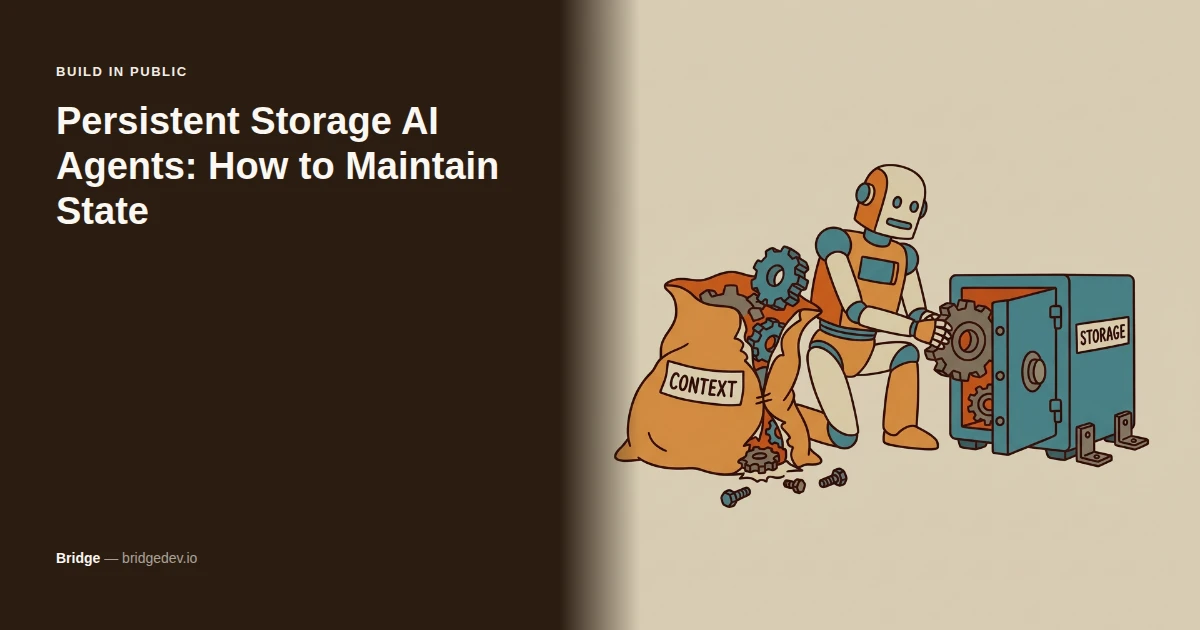
Software teams increasingly delegate multi-step engineering tasks to autonomous assistants, but relying on raw context buffers causes prompt bloat and silent state drift. The long-term answer is persistent storage AI agents can reference across reboots: treating structured specification files and external persistence as the canonical source of truth rather than transient prompt tokens.
Key takeaways
- Massive context windows do not solve long-term agent memory; large prompt buffers increase operational cost, degrade retrieval precision, and invite silent attention drift.
- External persistent storage gives autonomous coding assistants durable state across restarts, decoupling project requirements from ephemeral conversation sessions.
- Structured file trees and schema-validated markdown specifications outperform unstructured vector database embeddings for deterministic code generation.
- Cross-tenant isolation in shared agent memory systems requires strict cryptographic tenancy boundaries, not merely soft logical tags on shared storage tables.
The Context Window Illusion
Context windows continue to expand across modern language models, reaching millions of tokens. This expansion creates an illusion: the assumption that engineering teams can dump entire repositories, task backlogs, chat histories, and dependency graphs into an active prompt buffer and expect reliable execution. In practice, stuffing context leads directly to performance degradation. As context scales, models suffer from needle-in-a-haystack retrieval decay, high latency, and compounding inference costs on every turn.
When an autonomous system operates over hours or days, in-context state behaves like volatile RAM without a swap disk. Experimental work on running autonomous agent swarms in games like Minecraft and Mindustry demonstrates that long-horizon tasks collapse when agents rely solely on rolling context windows; agents lose intermediate goals, cycle through repetitive loops, and overwrite previous decisions. The limits of massive context windows become acute during complex software implementation: the model forgets architectural boundaries established fifty messages earlier.
Autonomous agents do not need infinite prompts. They need structured external memory systems that persist across process restarts, model upgrades, and session timeouts.
Enter Persistent Storage AI Agents
The developer tooling ecosystem is shifting from transient chat threads to durable agent storage. If autonomous systems are going to execute complex coding workflows, they need dedicated virtual filesystems and persistent volumes. These environments allow an agent to clone a repository, edit files, record scratchpad thoughts, run automated test suites, and pause execution without losing its work tree.
Persistent storage AI agents rely on a layered memory architecture:
- Working memory: the immediate context window holding the current task, recent tool calls, and immediate compiler feedback.
- Episodic memory: past execution logs, failed test traces, and user review comments stored in durable append-only ledgers.
- Semantic and structural memory: project architecture specifications, database schemas, API boundaries, and domain invariants stored in versioned files.
Decoupling state from the model runtime prevents context window exhaustion. Instead of paying thousands of tokens on every inference step to remind an assistant about project conventions, the system queries structured files on demand. When an agent crashes or hits an execution timeout, another process can pick up the exact state by mounting the same volume.
Production Patterns for Agent State Management
Rather than maintaining execution context exclusively inside LLM prompts, production agent systems separate durability from retrieval. In practice, long-running agent implementations converge on two primary architectural patterns: relational state checkpointing and multi-tiered hierarchical memory.
Relational checkpointing ensures that an autonomous agent can recover deterministically from process crashes, rate limits, or network timeouts. In frameworks like LangGraph, PostgresSaver provides relational checkpointing by writing serialized execution snapshots to database tables on every graph node transition, indexed by thread identifier. When an agent pauses execution to await human approval or encounters a container restart, the system does not recompute past steps; it reloads the latest verified state snapshot directly from the relational backend.
Multi-tiered hierarchical memory organizes storage analogously to computer hardware architecture. The Letta framework adapts an operating system memory hierarchy for agents, separating state into in-context core memory blocks that the model edits via tool functions, searchable relational recall memory, and external archival storage, as outlined in deep dives into Letta memory models. Core memory acts as RAM, containing critical instructions and user preferences that remain visible within every prompt. Archival memory functions as disk storage, queried selectively through semantic search tools only when historical context is required.
Security and Tenant Isolation
Persistent storage introduces severe multi-tenant data isolation challenges. When developers store proprietary specifications, internal architecture designs, and API contracts in cloud storage for agents to read, soft isolation is unacceptable.
Recent security research into cross-tenant compromise patterns in managed cloud infrastructures reveals how multi-tenant backends fail when isolation relies solely on logical row-level metadata tags or shared cache layers. A single misconfigured query or upstream parser flaw can leak one tenant's project context into another tenant's agent retrieval pipeline. In agentic workflows, such leaks do not just expose data to human eyes—they can inject foreign system instructions into another user's prompt chain.
Defending against cross-tenant data leakage requires architectural boundaries rather than soft application filters:
- Cryptographic tenancy boundaries: Multi-tenant storage backends must enforce per-tenant encryption keys, ensuring that even if an execution node accesses raw data records, decryption keys remain bound to verified tenant sessions.
- Dedicated vector namespaces and partition isolation: Embedding stores and index partitions must remain strictly partitioned, preventing semantic nearest-neighbor queries from traversing tenant boundaries during approximate index traversal.
- Direct-to-provider execution: Enterprise architectures route inference payloads directly using isolated provider API keys, ensuring that intermediary caching layers do not mix state buffers or execution histories across distinct tenant boundaries.
The Pitfalls of Vector-Only Agent Memory
A common failure mode in agent architecture is treating a vector database as the primary state engine. In naive implementations, systems embed raw session logs, task notes, and scratchpad updates, chunk them into fixed token windows, and store them in an unstructured semantic index. Whenever an agent plans its next step, it runs a top-k nearest-neighbor similarity search to assemble prompt context.
This pattern breaks down quickly in production. As detailed in MinIO's analysis of AI agent memory architecture patterns, vector retrieval lacks structural hierarchy and deterministic guarantees:
- Semantic confusion: Deprecated requirements or rejected architectural proposals often share high cosine similarity with active feature queries, causing agents to resurrect abandoned design decisions.
- Loss of chronology: Early debug logs or temporary workarounds can rank above recent schema migrations, confusing the agent about the current state of the codebase.
- Incomplete dependency graphs: Semantic distance does not model topological constraints, such as an API endpoint strictly requiring a preceding database migration.
Production architectures solve this by establishing a two-layer persistence model. An ACID-compliant relational or document store acts as the canonical system of record, preserving strict chronology, versioning, and task dependencies. Vector indexes and semantic graphs are relegated to derived context layers—disposable caches that can be rebuilt whenever state desynchronizes.
The long-term answer
The durable approach to agent state management is plain, structured files versioned alongside your codebase. Do not rely on ephemeral chat histories, and do not entrust architectural memory to unstructured vector embeddings. Write specs into discrete markdown artifacts that state primary goals, architectural invariants, explicit non-goals, and serialized task lists.
When an autonomous system operates on clean markdown files, state becomes portable, auditable, and resilient across model generations. To implement this pattern in your own workflow, follow our guide on how to structure AGENTS.md as an index for AI agents.
This architectural discipline shapes Bridge: a mobile planning workspace where captured notes cluster into constellations and compile into structured markdown specification files—Build Plans—that downstream coding agents can implement against. Bridge is pre-launch, with an Android release planned for November 2026, and focuses on getting the upstream specification right rather than generating code. Grounding downstream agents in persistent, verified files before implementation begins provides the deterministic boundaries that statistical models cannot generate on their own.
Frequently asked questions
Why not store agent state directly in prompt history?
Prompt history is transient and computationally expensive. As conversation logs grow, latency increases, inference costs compound on every message, and language models suffer from attention decay. External persistent files decouple long-term project requirements from immediate runtime context.
What files should an autonomous coding agent read for state?
An agent should read structured markdown files: an index file like AGENTS.md for routing, an architecture specification for system boundaries, a data schema file for domain models, and a sequentially ordered task list with clear acceptance criteria.
How does persistent storage prevent agent hallucinations?
Persistent storage bounds the decision space. When an agent verifies its plan against an explicit file defining schema constraints and non-goals, it does not have to invent details from statistical memory. The file provides deterministic grounding.