
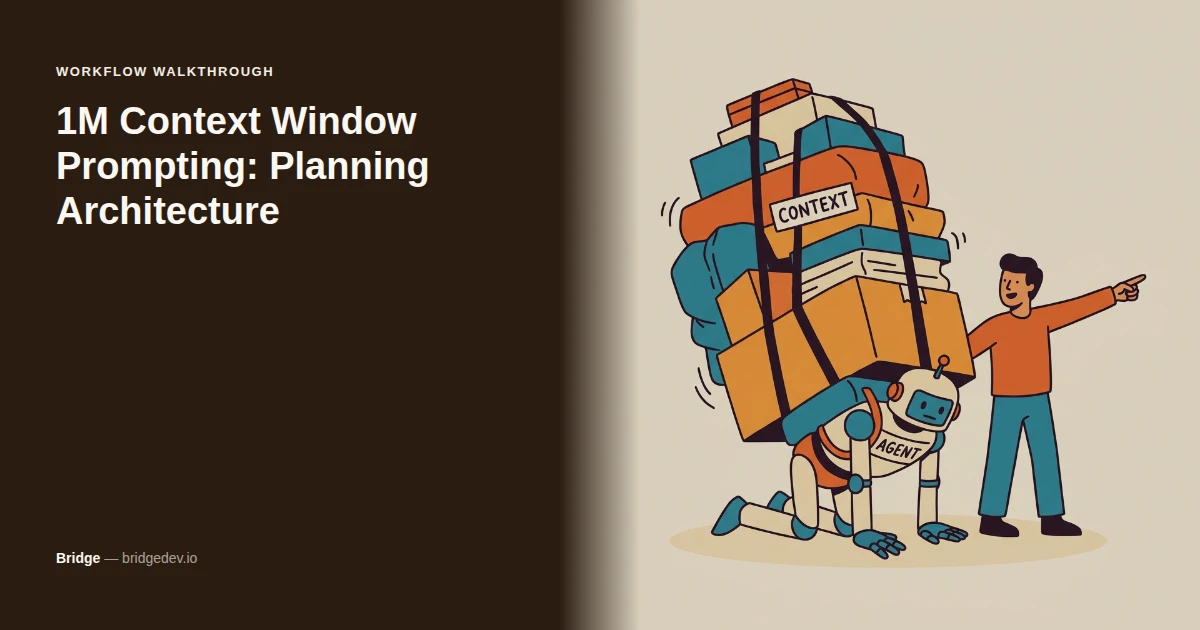
Large language models now ingest entire repositories in a single inference call, but uncurated inputs degrade planning accuracy. Effective 1M context window prompting treats context as an architectural boundary rather than an unbounded dump. The durable strategy is strict intermediate structuring: turning scattered developer inputs into modular, deterministic markdown specifications before invoking downstream coding agents.
Key takeaways
- Raw codebase dumps trigger attention dilution, causing foundation models to hallucinate file paths and invent ungrounded dependencies.
- Hierarchical prompt architecture places critical task constraints and acceptance criteria at the terminal end of massive context payloads.
- Intermediate planning specifications prevent downstream coding agents from making flawed architectural assumptions during implementation.
- Scoped semantic clusters generate higher precision project plans than uncurated workspace history dumps.
The Rise of 1M-Context Models
Frontier foundation architectures have turned the million-token window into an accessible standard. Releases such as Mistral Large 4 demonstrate how open foundation models are scaling input capacity across enterprise workloads, as detailed by Mistral AI. Concurrently, architectures like Step 5 Preview and DeepSeek 4.1 Flash have driven down the latency and inference cost associated with large-scale token ingestion.
For software teams, this transition removes the traditional token budget constraint. Developers no longer need to spend hours chunking pull requests or isolating single functions before querying a model. However, having room for a million tokens does not mean an engineer should paste an entire Git repository into a prompt. As explored in our 2M token context guide, expanding the capacity of the system merely shifts the engineering bottleneck from token compression to prompt architecture and retrieval discipline. When planning complex software, more input capacity without structural guidance increases output variance.
Why More Context Doesn't Mean Better Focus?
Synthetic evaluations frequently report near-perfect retrieval across million-token windows. Yet as evaluations of benchmark methodology by Interconnects demonstrate, synthetic benchmarks test isolated needles in uniform text, which diverges sharply from multi-hop reasoning across messy codebases. When an engineer dumps dozens of directories, dependency manifests, and conversation threads into a prompt, attention dilution occurs.
The attention mechanisms across massive transformer layers disperse weight over non-critical tokens: boilerplate configurations, test fixtures, and obsolete migration files. When tasked with architectural planning, the model cannot distinguish between active business logic and deprecated utility wrappers. The result is plan drift: the model generates specifications that reference obsolete schemas, duplicate existing helper modules, or hallucinate missing endpoints. Context without hierarchy is simply noise.
Structuring Prompts for Massive Contexts in 1M Context Window Prompting
To maintain deterministic reasoning, 1M context window prompting requires strict structural hierarchy. Treating the context window as an organized memory hierarchy rather than a linear transcript ensures the model attends to core constraints over background noise.
An effective context layout groups reference material into distinct functional layers:
<!-- CONTEXT PAYLOAD STRUCTURE -->
1. System Role & Planning Objectives
2. Architectural Boundaries (Schemas, API Contracts)
3. Scoped Codebase Files (Target Modules Only)
4. Reference Notes & Feature Requirements
5. Task Constraints & Output Schema (Placed at terminal end)
Placing task instructions, negative constraints, and output formatting rules at the terminal end exploits recency bias. Language models attend more reliably to instructions situated near the end of the context window. Furthermore, rather than dumping thousands of lines of raw source code, using index files helps the model traverse relationships cleanly. Implementing this discipline aligns with structuring AGENTS.md files as lightweight navigation indices, preventing the context window from suffocating under uncurated text.
Extracting Actionable Specs from Noise
Generative models inherently default to code synthesis. When presented with a broad feature request, the system often rushes to spit out fragmented implementation files without validating the underlying system contract. In complex architectures, skipping specification leads to cascading integration errors.
To extract actionable specifications from messy developer context, enforce strict planning boundaries:
- Constrain the output schema: Require the model to emit markdown files divided into problem briefs, data contracts, and sequenced task lists.
- Apply negative constraints: Explicitly prohibit raw implementation code in the planning phase (
Do not emit code implementation; output system interface contracts only). - Demand explicit trade-off analyses: Require the model to justify architectural selections against existing codebase conventions.
This separation of concerns mirrors the Spec, Plan, Build, Review workflow. By isolating the specification phase, developers force the model to solve edge cases, state lifecycles, and database migrations before any code is written.
Integrating High-Context Models in Bridge
Bridge approaches high-context capabilities through structured scoping rather than brute-force ingestion. Bridge is a mobile notes workspace for software ideas, capturing raw thoughts on transit or between meetings. Instead of asking developers to dump raw, uncurated history into an open prompt, Bridge automatically groups semantically related notes into themed constellations.
When a constellation reaches sufficient density, tapping "Start a venture" generates a full Build Plan: markdown specification files including an index, the brief, the user flow, the architecture, the data model, ordered tasks, acceptance criteria, scope, and an AGENTS.md overlay. Because the plan is derived from a focused constellation rather than an entire workspace dump, the high-context model operates on high-signal material. Conversations can be explicitly scoped to individual notes, a constellation, or a generated plan. On paid plans (from Discover to Refine), users provide their own Anthropic, OpenAI, or Google Gemini API keys, executing high-context runs directly against their provider without arbitrary platform markups.
The long-term answer
The durable answer to expanding model capacity is not finding ways to prompt larger raw text blobs; it is building a modular specification pipeline. Foundation models will continue to scale context windows toward ten million tokens and beyond, but the fundamental mechanics of attention and logical cohesion remain unchanged. High-leverage engineering teams front-load design decisions into structured markdown specifications, treating execution as downstream verification. To implement this pattern across your agent stack, explore our Spec, Plan, Build, Review workflow guide.
Frequently asked questions
Does a larger context window eliminate the need for retrieval-augmented generation?
No. High-context windows allow you to process extensive documents at once, but unindexed inputs dilute model attention. Retrieval mechanisms remain vital for isolating the specific modules, schemas, and requirements relevant to a discrete planning task.
Where should critical constraints sit within massive prompt payloads?
Place operational constraints, negative rules, and required output schemas at the very end of your prompt payload. This leverages recency bias in transformer architectures, ensuring the model prioritizes execution boundaries over background reference documentation.
How does an intermediate specification stop agent drift?
An intermediate specification establishes explicit interfaces, acceptance criteria, and task sequences before any code is generated. Downstream coding agents execute against these verified contracts rather than making ad-hoc assumptions from raw conversational history.